
Wayne County Crime News Sources
The Wayne County Sheriff's Office press-release archive is where official announcements live. Year filters let you browse older releases, and the sheriff's homepage posts recent public-safety items. Just know what it is not. It is no daily arrest blotter, and it never lists every person booked. Think of it as the agency's incident-news channel rather than a custody feed.
The jail's current-inmate interface answers a different question: who is in custody now. A listing may show a surname-first name, a current photograph, a View Charges link, and a VINE notice link where one is supplied. Filters are limited. There is no verified booking-date, city, agency, release, or charge search, so a person released, transferred, cited, or booked under another spelling may simply not appear. The captured official sheriff news archive shows this primary incident channel at work.
Treat any dated news release as a starting point. Then check the official systems. Custody and court status live there, and only those sources settle the question.
Wayne County News Outlet Map
The media scene in Wayne County is small. One newspaper feature keeps readers current on local incidents, and a few commercial pages post booking data on their own schedules. Go to official sources first. They originate the custody record and the court file, so nothing else outranks them.
| Outlet | Coverage | Photos? | Where to verify |
|---|---|---|---|
| Wayne County Sheriff | Selected press releases, alerts, and public-safety news | May include agency-released images; current inmate photos are in the roster | Official press archive and inmate page |
| Times Republican & New Era | Recurring Wayne County Sheriff's Report, often spanning about one or two weeks | The observed report was text-based, not a mugshot grid | Sheriff, booking record, and court case |
| Seymour Herald | Weekly report with Seymour Police and sheriff entries labeled separately | No recurring mugshot gallery was found | Named agency, then court |
| Busted Newspaper | Unofficial cumulative Wayne County page with deep pagination | Yes, when available | Compare with sheriff and court records |
| Recently Booked | Unofficial Wayne page limited to a recent 30-day window | Yes, when supplied | Compare with sheriff and court records |
| Mugshots.com | Wayne County taxonomy displayed zero records when checked | No active local inventory was shown | Do not treat the category as a county feed |
Humeston has no standalone blotter of its own. Nor does the county have a dedicated digital newsroom with a regular mugshot roundup. A regional outlet may cover a big event in Wayne County, but scattered stories do not add up to a steady arrest source. One-off coverage is just that.
Wayne County Sheriff's Report
The weekly Times Republican & New Era carries a recurring Wayne County Sheriff's Report. A single issue can span roughly one to two weeks of events. Each entry may list the date, the agency that responded, a road or block, the community, the type of incident, and a short outcome. Some issues also print the number of new jail bookings for the period. That figure gives useful context. It is not a name-by-name feed, though.
Corydon, Seymour, Humeston, and the county's smaller towns all show up in its pages. Pay attention to agency labels in Seymour items. A call handled by Seymour Police starts with the city department, while a later booking and booking image belong to the sheriff. Court results then sit with Iowa's court record. Watch for affiliated papers running the same report too, since a reprint is not a second confirmation.
What makes this feature valuable is narrative. It tells a story the roster cannot. The trade-off is structure: you won't find fields to verify every arrest, bond, or release. Read it as an event lead, and keep the agency label attached.
Note: A newspaper's period total names no one and cannot stand in for a complete Wayne County arrest log.
How Wayne County Photos Reach News
A Wayne County booking photo starts at jail intake. The image becomes public under the rules that apply. County inmate cards show photos when they have them. A newsroom then gets the picture one of a few ways. It may come from an agency release, the public roster, or a records request to the sheriff. Iowa's public-records law still permits redaction or withholding on specific legal grounds.
What happens next varies. The weekly sheriff report runs incident narratives but no photo gallery. Commercial county pages take the opposite approach. They pair names with images and fields pulled from public sources, on their own timing and labels. Wayne County does not control those updates. A missing photo can mean the source lacked it. Or an editor skipped it. It does not mean no arrest happened.
Trace Wayne County Arrest Stories
A name in a news item is the start of the trail. It is not the end. Three things must be separated: who is in custody now, what the booking file says, and how the court resolved it. Each has its own source.
- Read the story closely. Record the full name, event date, community, and agency named by the outlet.
- Check the sheriff's current-inmate roster. A match can indicate current custody, but no match may mean release, transfer, citation, delay, withholding, or a spelling issue.
- For a released person or an older event, request the releasable booking or jail-calendar record from the Wayne County Sheriff's Office for a narrow date span.
- Search Iowa Courts Online. Use Wayne County or a known case number to avoid mixing people with similar names.
- Open the Case ID and review criminal charges, docket events, and disposition. Clerk-terminal or subscriber access may be needed for some functions.
- Return later if the case is pending. An initial article rarely contains the last court event.
The Wayne County booking and roster treatment walks through the official custody channels and records requests in detail. For court questions, the Wayne County Clerk of Court sits at 641-632-2040. The staff can explain how access works. They cannot offer legal advice.
Wayne County News Before Disposition
News coverage almost always lands before a court has touched the case. Iowa Rule of Criminal Procedure 2.2 sets the clock: an arrested person goes before a magistrate within 24 hours when one is available, and within 48 hours no matter what. No plea is entered at that first appearance. Release review and other rights come up then instead.
A preliminary hearing, if not waived or replaced by an indictment or trial information, follows within ten days for someone held in custody, or twenty days for someone released, with good-cause extensions allowed. After that, the court record may show dismissal, acquittal, plea, deferred judgment, or sentence. So a sheriff report from the same week tells you an arrest happened. It cannot tell you how it ended.
- Booking
- Jail intake after an arrest.
- Arraignment
- A court stage at which charges are addressed and a plea is entered.
- Disposition
- The recorded outcome of a charge or case.
- Expungement
- A statutory process that changes access to qualifying records after a court order.
Charges can shift as a case moves forward. They may be amended, reduced, dismissed, or end in acquittal.
Wayne County Third-Party Pages
Commercial pages rank behind the sheriff and the courts. Busted Newspaper keeps a cumulative Wayne County section with near-daily entries. Its cards can show a photo, name, age, booking time, physical details, charges when available, agency, and bond. Many Wayne records list no charge at all. Treat a blank charge field as missing data, not a cleared one.
Recently Booked covers Wayne County but only the prior 30 days. The page says it refreshes several times a day. Its own FAQ admits timing depends on the source and is often daily. It also warns that Wayne County provides no charge data. The Recently Booked Wayne County landing shows that secondary landscape in full.
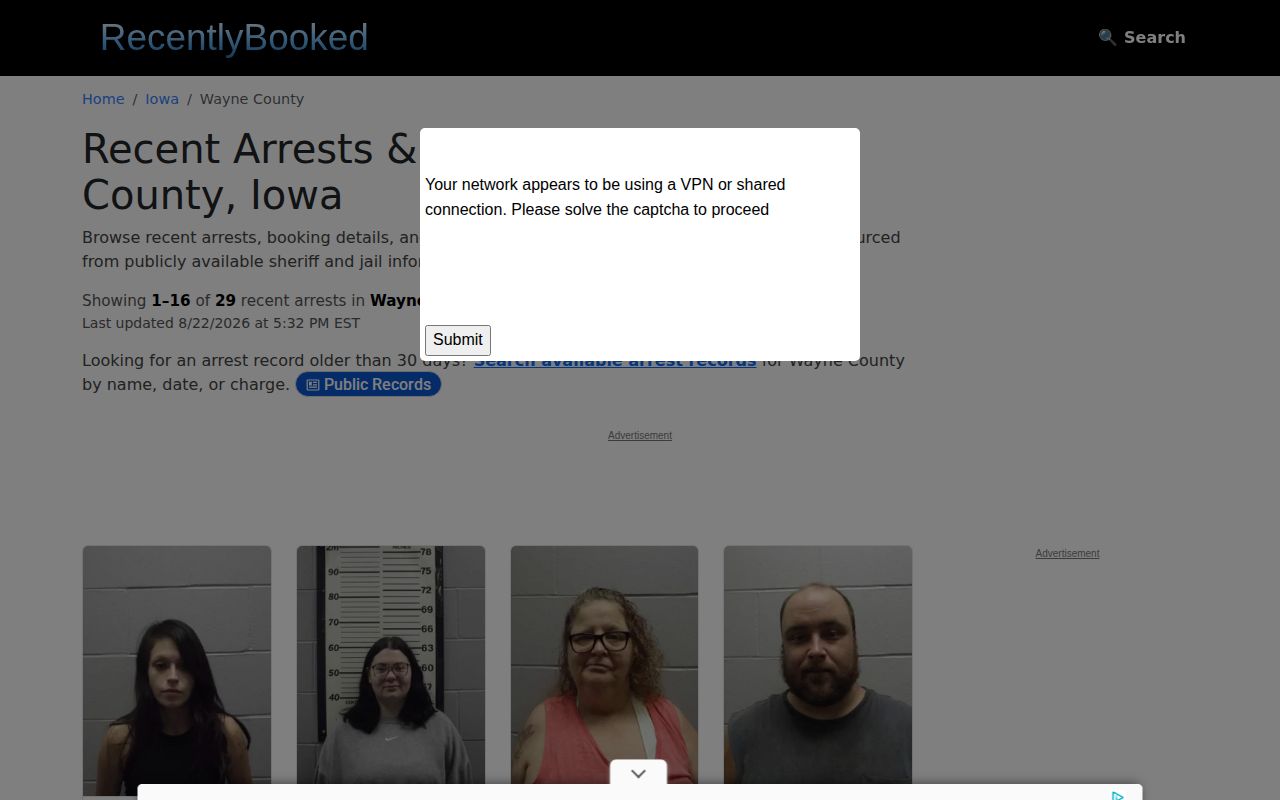
That image is a capture of a county landing page. It is not an official Wayne County record. Confirm every identity, custody status, charge, and outcome with the sheriff and the court before relying on it.
Not every site delivers. Mugshots.com showed zero records in its Wayne category. Arrests.org and Mugshots.zone had no verified Wayne County, Iowa section at all. JailExchange offers a county jail guide rather than a live booking feed. So a claim that every mugshot site covers this county is simply false.
Note: Secondary pages may lag, duplicate each other, or go stale, and none tracks the later court result.
Wayne County City Coverage
Coverage in Wayne County splits by town. Corydon has no police department of its own anymore, so its incidents flow straight to the sheriff. Seymour works differently. Its police department opens the file for city events, while the county jail intake side still lands with the sheriff. Humeston is murkier. No active municipal department or online log exists there, so the sheriff remains the practical contact, though deputies may not handle literally every call.
One newspaper report pulls together all three communities. The commercial roster pages are countywide, not city-specific. A city label helps you narrow a search. Still, it won't filter the Wayne County arrest roster down to a single town. To confirm a match, line up three things: the named agency, the event date, and the court case number.